
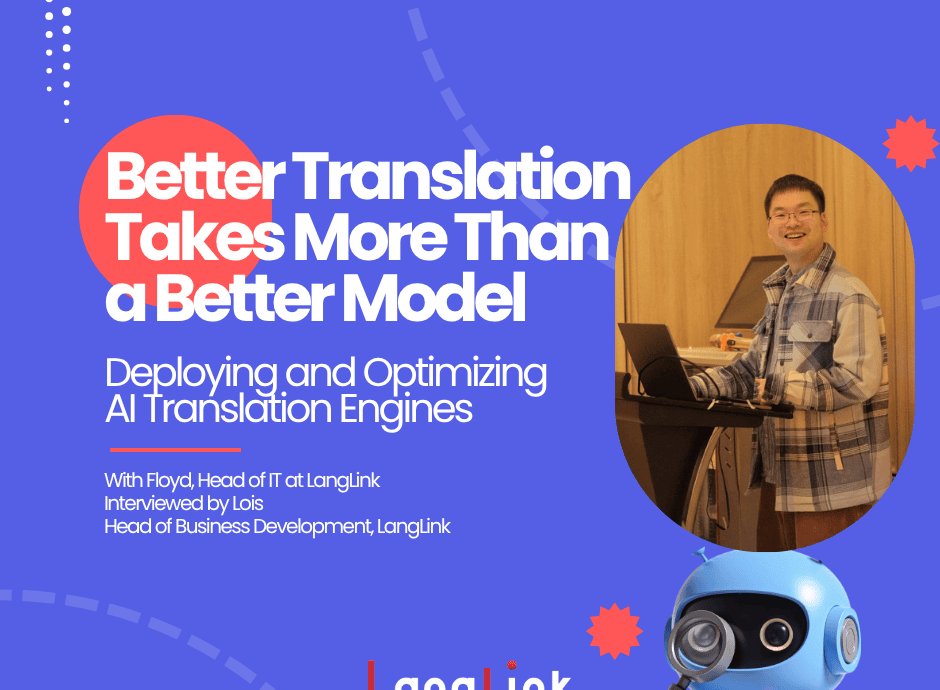
Deploying and Optimizing AI Translation Engines: An Interview with Floyd, Head of IT at LangLink
AI 翻译引擎部署与调优:专访 LangLink IT 负责人 Floyd
随着 AI 翻译能力不断提升,越来越多客户开始将 AI 翻译引擎接入实际业务,尤其是在 IT 和通用内容领域。但从选好一个模型,到稳定完成一个翻译项目,中间还有不少工作:术语要统一,上下文要准确,文件要能顺利进入审校,客户的数据也要得到妥善保护。
As AI translation improves, more clients are integrating AI translation engines into their day-to-day operations, particularly for IT and general content. But there is still a lot of work between choosing a good model and delivering a successful translation project. Terminology needs to be consistent, context needs to be accurate, files need to move smoothly into review, and client data needs to be properly protected.
作为 LangLink 的 BD 负责人,我关心的是这些技术选择最终能为客户带来什么。好译文既要读起来自然,也要符合客户的表达习惯和使用场景;效率提升,也要体现在项目的交付时间和实际返工量上。这些结果,需要模型能力、语言资产和生产流程共同支撑。
As Head of Business Development at LangLink, I want to understand what these technology choices actually deliver for our clients. Good translations need to read naturally while reflecting the client’s preferred style and intended use. Efficiency gains also need to show up in delivery times and the amount of rework required. Achieving those results takes model capability, language assets, and production workflows working together.
因此,我和我们 IT 部门负责人 Floyd 聊了聊 AI 翻译引擎的部署与调优。从模型选型,到提示词、术语库和翻译记忆库的配合,再到质量评估、数据安全与人工参与,我们希望把“好模型怎样产出好译文”这件事,放回客户的真实项目中谈清楚。
With that in mind, I sat down with Floyd, our Head of IT, to discuss deploying and optimizing AI translation engines. We covered model selection, the use of prompts alongside termbases and translation memories, quality evaluation, data security, and human involvement. Our aim was to explore what it takes for a good model to produce good translations in real client projects.
AI 翻译引擎的选型与部署
Selecting and Deploying AI Translation Engines
Lois:Floyd,我们先从一个很直观的感受聊起。把一段文字交给 AI,结果往往已经不错了。为什么到了客户的真实项目里,仍然会有那么多问题?
Lois: Floyd, let’s start with something many of us have experienced. Give AI a passage to translate, and the result is often quite good. Why do so many problems still arise in real client projects?
Floyd:因为一段文字翻得好,只是完成项目的一部分。真实项目里,可能有上千个句段,需要保持术语和风格一致,还要处理格式、变量和占位符。
模型本身可能出现幻觉、指令遵循不稳定,或者因为上下文有限而前后表达不一致。到了交付端,就可能表现为漏译、多译、术语不统一或风格漂移。文件处理不当,也会造成内容丢失、位置错乱。有些问题单看一句话发现不了,放进完整文件或产品界面,才会暴露出来。
Floyd: Because translating one passage well is only part of delivering a project. A real project may contain thousands of segments. You need to maintain consistent terminology and style while also handling formatting, variables, and placeholders.
The model itself may hallucinate, follow instructions inconsistently, or produce inconsistencies because it has limited context. In the deliverable, those issues can show up as omissions, additions, inconsistent terminology, or shifts in style. Errors in file processing can also cause content to disappear or end up in the wrong place. Some problems are hard to spot in an isolated sentence; they only become apparent in the complete file or product interface.
Lois:那客户很自然会想,换一个更强的模型,问题是不是就少了?
Lois: A client might naturally think, “Wouldn’t a more capable model solve more of these problems?”
Floyd:模型能力会影响结果,但要看具体问题出在哪里。如果是语义理解不够好,更强的模型可能有帮助;如果是格式标记丢了、文件切分不合理,或者译文没有正确写回原文件,换模型也解决不了整个问题。
所以我们需要区分:哪些是语言生成的问题,哪些是生产流程的问题。先找准原因,调优才有方向。
Floyd: Model capability does affect the result, but we need to identify the actual cause. If the model is struggling to understand the meaning, a more capable model may help. But if formatting tags are lost, the file is segmented poorly, or translations are not written back into the original file correctly, changing the model will not solve the whole problem.
So we need to distinguish between problems with language generation and problems in the production workflow. Once we know the cause, we can decide what to optimize.
Lois:从我们服务客户的角度看,这也是技术团队需要介入的地方。你们现在主要在解决哪些问题?
Lois: From a client service perspective, that’s where the technical team needs to get involved. What are you focusing on at the moment?
Floyd:一个重点是把 AI 接进现有翻译流程。比如,我们开发的 memoQ AI Hub,让译员在 memoQ 里使用 AI,同时利用项目中的术语和翻译记忆库(TM),不必反复复制、粘贴。译员可以根据 TM 匹配分数,选择哪些句段交给 AI 处理,并查看匹配到的术语和参考来源,译文返回后再做术语核查。
其他工具也各有分工:langlink-tools 支持批量翻译、参考资料检索、术语抽取和质量检查和多家 AI 翻译引擎对比;xliff-mcp 则让 AI agent 处理 XLIFF 双语文件的解析、tag 保护和译文回写。
这些工具共同要做好的是识别文件结构,保护 tag,并妥善处理变量和占位符等不可随意改动的内容。最终让生成的双语文件顺利进入审校,减少语言同事花在搬运内容和修复格式上的时间。
Floyd: One priority is integrating AI into existing translation workflows. For example, the memoQ AI Hub we developed lets translators use AI within memoQ, drawing on the project’s terminology and translation memory, or TM, without repeatedly copying and pasting content. Translators can use TM match scores to decide which segments to send to AI, see the matched terms and reference sources, and run terminology checks once the translations come back.
Our other tools have distinct roles, too. langlink-tools supports batch translation, reference retrieval, terminology extraction, quality checks, and comparisons across multiple AI translation engines. xliff-mcp enables AI agents to parse bilingual XLIFF files, protect tags, and write translations back into the files.
These tools all need to recognize file structures, protect tags, and correctly handle variables, placeholders, and other elements that must not be changed arbitrarily. The aim is to produce bilingual files that can move straight into review, reducing the time our language specialists spend moving content around and repairing formatting.
Lois:如果客户问我“哪个 AI 翻译引擎最适合我们”,你会建议我从哪里入手提供解决方案?
Lois: If a client asks me which AI translation engine is best for them, where would you suggest I start in putting together a solution?
Floyd:我会建议先从客户的实际需求入手,了解他们需要翻译哪些内容、涉及哪些语言对,以及译文最终会用在什么场景。技术文档、软件界面和游戏剧情,对 AI 翻译引擎的要求很不一样;同一个引擎在不同语言对上的表现也可能有差异。
最好拿客户有代表性的材料测试,覆盖真实的语言对、内容类型和文件格式,再由语言专家按统一标准评估。除了译文质量,还要看后续修改量、处理速度和成本。
Floyd: I’d start with the client’s actual needs: what they need translated, which language pairs are involved, and where the translations will be used. Technical documentation, software interfaces, and game narratives place very different demands on an AI translation engine. The same engine can also perform differently across language pairs.
Ideally, we should test representative client materials covering the actual language pairs, content types, and file formats, then have language specialists evaluate the results against consistent criteria. Beyond translation quality, we also need to consider how much editing is required, processing speed, and cost.
Lois:也就是说,一个 AI 翻译引擎测试得分高,不一定适合客户的所有内容。那是不是可以根据内容类型,搭配使用不同的模型?
Lois: So a high score in a test doesn’t mean an AI translation engine is right for all of a client’s content. Could we use different models for different content types?
Floyd:可以。句式固定、重复率高的内容,可以评估是否适合使用成本较低的模型;需要复杂语境判断的内容,再使用能力更强的模型。
同样,项目规则也应该跟着内容变化。按场景选择模型,再配合相应的提示词和参考资料,会比所有内容采用同一套配置更便于控制质量和成本。
Floyd: Yes. For repetitive content with predictable sentence patterns, we can assess whether a lower-cost model is suitable. For content that requires more complex contextual judgment, we can use a more capable model.
Project rules should also vary with the content. Choosing models for specific use cases and pairing them with appropriate prompts and reference materials makes it easier to manage quality and cost than applying one configuration to everything.
提示词与语言资产如何配合调优
Combining Prompts and Language Assets to Improve Translation
Lois:模型选好以后,客户可能还会反馈:“翻译出来意思没错,不过不太符合我们的表达风格。”这种情况,你一般从哪里入手?
Lois: Even after we’ve chosen a model, a client might say, “The translation gets the meaning right, but it doesn’t really match our writing style.” Where would you start in that situation?
Floyd:先看我们有没有把要求说清楚。只告诉模型“请翻译以下内容”,它并不知道客户希望采用什么语气、遵循什么术语,或者哪些代码和符号必须保留。
这些相对固定的要求,可以整理成项目提示词模板。再根据当前需要翻译的句段,补充相关术语和上下文。这样做,也方便后续检查到底是哪条规则需要调整。
Floyd: First, I’d check whether we’ve made the requirements clear. If we only tell the model to “translate the following text,” it won’t know what tone the client wants, which terminology to use, or which code and symbols must be preserved.
We can put those relatively stable requirements into a project prompt template, then add relevant terminology and context for each segment being translated. That also makes it easier to identify which rule needs adjusting later.
Lois:那提示词写得足够详细,是不是就能保证模型按要求翻译?
Lois: If the prompt is detailed enough, can we guarantee that the model will translate exactly as instructed?
Floyd:还不能。提示词能提供指引,但模型不一定每次都严格遵循。
比如“请使用客户术语”这句话本身不够,我们要先匹配当前内容里的术语,把标准译法提供给模型,翻译后再核查。术语库本身也要准确,适用的语言对和项目范围要清楚,否则模型拿到的参考就可能有问题。
Floyd: Not quite. Prompts provide guidance, but the model may not follow every instruction consistently.
For example, simply saying “use the client’s terminology” is not enough. We need to match terms in the current content against the termbase, supply their approved translations to the model, and check the output afterward. The termbase itself must also be accurate, with clearly defined language pairs and project scope. Otherwise, the references we give the model may be wrong or unsuitable.
Lois:软件界面里有些文字特别短,看起来很简单,翻译时却经常需要向客户确认具体含义。是不是也和提供的上下文信息不够有关?
Lois: Some software interface strings are very short and look straightforward, yet translators often need to ask the client what they mean. Is that also a matter of insufficient context?
Floyd:是的。短句不等于容易翻。没有界面信息,模型很难判断这段文字是按钮上的标签、一条提示,还是某个状态描述。
这时,字符串标识、开发者注释和界面说明往往很有帮助。还要告诉它有没有长度限制,并保护好变量和占位符。长文则可以补充前文摘要和关键设定。不过,上下文也要选得准:它会占用模型的输入容量、增加处理开销,塞进太多无关信息,反而可能干扰翻译。
Floyd: Yes. Short doesn’t necessarily mean easy to translate. Without information about the interface, the model may struggle to tell whether a string is a button label, a prompt, or a status message.
String identifiers, developer comments, and interface descriptions can be very helpful here. We also need to specify any length limits and protect variables and placeholders. For longer texts, we can provide summaries of preceding content and key background information. But we need to choose that context carefully: it takes up input capacity and adds processing overhead. Too much irrelevant information can actually interfere with the translation.
Lois:接下来,我们来聊聊客户已有的语言资产。很多客户积累了多年的翻译记忆库,采用 AI 翻译以后,这些历史译文还能发挥什么作用?
Lois: Next, let’s talk about clients’ existing language assets. Many have built up translation memories over the years. Once they adopt AI translation, how can those previous translations continue to help?
Floyd:翻译记忆库仍然很有价值。它保存的历史译文,可以为当前相同或相似的句段提供参考,让 AI 有依据可循。
对于适合直接复用的内容,还可以减少不必要的模型调用。不过,先要确认这些译文适用于当前项目。历史内容如果过时,或者采用的术语和风格与当前项目要求不同,就不能不加判断地使用。
Floyd: Translation memories remain valuable. They hold previous translations that can serve as references for identical or similar segments, giving AI something concrete to work from.
Where a translation is suitable for direct reuse, we can also avoid unnecessary model calls. But first, we need to confirm that it is appropriate for the current project. If it is outdated, or follows terminology and style requirements that differ from the current project, we cannot reuse it without checking.
Lois:你之前也提到过 RAG。对不熟悉技术的客户,我们可以怎样向客户解释它和传统 TM 匹配的区别?
Lois: You also mentioned RAG earlier. How would you explain the difference between RAG and traditional TM matching to a client who isn’t familiar with the technology?
Floyd:可以理解为多了一种找参考资料的方式。传统 TM 匹配主要看句段是否相同或相似;语义检索则有机会找到字面不同、但意思相关的内容。
RAG,也就是检索增强生成,是先检索相关资料,再让模型结合这些资料生成结果。在翻译项目中,传统 TM 匹配可以与语义检索搭配使用,扩大可参考的资料范围。但检索出来的内容仍然需要筛选,无关或不适用的资料太多,也可能干扰翻译。
Floyd: Think of it as another way to find reference material. Traditional TM matching primarily looks for identical or similar segments. Semantic retrieval can also find content that is related in meaning, even when the wording is different.
RAG stands for retrieval-augmented generation. It retrieves relevant material first, then asks the model to use that material when generating its output. In translation projects, we can combine traditional TM matching with semantic retrieval to draw on a broader set of references. But retrieved content still needs to be filtered. Too much irrelevant or unsuitable material can get in the way.
Lois:提示词、术语库、TM 和上下文信息都可以帮助改善翻译。实际做项目时,这些优化方法怎么搭配才比较合适?
Lois: Prompts, termbases, TMs, and context can all help improve translation. How should we combine them in an actual project?
Floyd:先看这类内容最容易出什么问题。技术文档通常优先考虑术语一致性和历史译文复用;软件界面要补足语境,检查长度、变量和格式;游戏剧情则更需要角色设定、风格指南和前文信息。
不同内容可以采用不同的模型和参考资料配置,但都需要衔接好后续的自动质量检查和人工审校。先检查术语、tag 和漏译等问题,再由语言专家做译后编辑。审核后的译文修改,再更新到对应的语言资产中,供后续项目复用。
另外,这条流程要能追踪:任务进行到哪里、失败发生在哪一步、译文有没有成功回写,都应该查得到。最好还能看到一条译文参考了哪些术语和历史译文。这样出了问题,才方便定位和调整。
Floyd: Start with the problems that particular type of content is most likely to encounter. For technical documentation, terminology consistency and reuse of previous translations usually take priority. Software interfaces need enough context, along with checks on length, variables, and formatting. Game narratives place more emphasis on character details, style guides, and preceding story content.
Different content can use different model and reference configurations, but all of them need to connect smoothly to automated quality checks and human review. We first check for issues such as terminology errors, tag problems, and omissions, then have language specialists post-edit the translations. Reviewed edits should be incorporated into the relevant language assets for reuse in later projects.
The workflow also needs to be traceable. We should be able to see how far a task has progressed, where a failure occurred, and whether the translation was successfully written back. Ideally, we should also be able to see which terms and previous translations informed each translated segment. That makes it easier to diagnose problems and make adjustments.
Lois:如果这些方法都尝试了,客户还想进一步定制,是不是就该考虑微调模型了?
Lois: If we’ve tried all these approaches and the client still wants more customization, is it time to consider fine-tuning the model?
Floyd:可以评估,但要看投入是否值得。微调需要高质量的双语平行语料,也就是配对的原文和译文,相比前面几种优化方法,语料准备和模型训练通常需要更长时间。基础模型升级后,还可能需要重新训练和验证。对于长期、风格要求明确,而且能够不断积累数据的项目,它可能是合适的选择。
不过,微调之前,我会先确认术语、参考资料和上下文有没有用好。有时问题出在这些基础环节,先解决它们,更容易判断投入是否带来了实际改善。
Floyd: It’s worth evaluating, but we need to weigh the benefits against the investment. Fine-tuning requires high-quality parallel bilingual data: paired source texts and translations. Preparing that data and training the model typically take longer than the approaches we’ve discussed. An upgrade to the base model may also require retraining and validation. Fine-tuning may be a good fit for long-term projects with clear style requirements and a continuing supply of suitable data.
Before going down that route, though, I’d check whether we’re making good use of terminology, reference materials, and context. Sometimes the problem lies in those fundamentals. Addressing them first makes it easier to assess whether the investment is delivering a real improvement.
翻译质量与成本评估及数据安全
Evaluating Translation Quality and Cost While Protecting Data
Lois:从 BD 的角度,我希望我们能向客户解释清楚,优化到底带来了什么变化。除了展示几段更好的译文,还应该看什么?
Lois: From a BD perspective, I want us to be able to explain clearly what an optimization has achieved for the client. Beyond showing a few better translations, what should we look at?
Floyd:先建立一个可供比较的基准。用一组固定的、有代表性的样本,记录优化前的表现,再对同一组样本采用相同的评估方法,比较优化前后的结果。也可以请语言专家在不知道译文来自哪个版本的情况下做盲评,减少主观预期的影响。
同时看真实项目里的变化:译员主要改了什么,修改量和译后编辑耗时有没有减少,返工量有没有减少。再结合自动 QA 报告、一次通过率,以及客户语言质量评估(LQA)的扣分情况,判断优化是否改善了实际交付质量。
这些指标还要持续跟踪。一次测试表现更好,还不足以说明后续项目也能保持同样的效果。译文读起来更顺,是一个信号,最终还要看真实修改量和质量评分的变化。
Floyd: Start with a baseline. Use a fixed set of representative samples to record performance before the change, then evaluate those same samples using the same method afterward. We can also ask language specialists to conduct blind evaluations, without knowing which version produced each translation, to reduce the influence of their expectations.
Then look at what changes in real projects. What are translators editing? Has the amount of editing decreased? Are they spending less time post-editing, and is there less rework? Combine those findings with automated QA reports, first-pass acceptance rates, and deductions in the client’s language quality assessment, or LQA, to see whether the optimization has improved the quality of actual deliverables.
We also need to track those measures over time. A better result in one test does not establish that subsequent projects will perform just as well. More fluent wording is a useful sign, but we still need to look at the actual editing required and changes in quality scores.
Lois:客户也会关注节省了多少成本。如果只比较模型调用费用,是不是容易低估实际投入?
Lois: Clients will also want to know how much they’re saving. If we only compare model usage fees, are we likely to underestimate the actual investment?
Floyd:是的。评估要占用语言专家的时间,模型版本变化后要重新测试,工具和规则也需要维护。如果流程出了问题,还有修格式、补漏译等返工成本。
因此,要看整个项目的投入。优先复用合适的历史译文、按任务难度配置模型,都可以减少不必要的开销。在支持提示词缓存的服务中,把固定规则放在提示词前面,也有机会降低重复调用的成本。真正省下来的,应该是完成合格交付所需的总成本。
Floyd: Yes. Evaluation takes time from language specialists. Model version changes require retesting, and tools and rules need ongoing maintenance. If something goes wrong in the workflow, there are also rework costs, such as repairing formatting and translating omitted content.
So we need to consider the whole project. Reusing suitable previous translations and selecting models according to task complexity can reduce unnecessary spending. Where a service supports prompt caching, putting stable instructions at the beginning of the prompt may also reduce the cost of repeated calls. What matters is reducing the total cost of delivering work that meets the required quality standard.
Lois:交付速度也是一样吧?AI 很快给出译文,未必代表项目就能很快交付。
Lois: I suppose the same applies to delivery speed. Just because AI generates a translation quickly doesn’t mean the project will be ready to deliver quickly.
Floyd:对。批量任务怎么安排,哪些可以并行处理,失败后能不能重试,中断后能不能继续,以及生成的文件能否直接进入审校,都会影响实际交期。
如果前面几分钟生成了译文,后面却花很长时间整理文件,效率提升就会被抵消。所以我们既要看模型的处理速度,也要看整条流程有没有让人反复等待和返工。
Floyd: Exactly. How batch jobs are scheduled, which tasks can run in parallel, whether failures can be retried, whether interrupted work can resume, and whether the resulting files can go straight into review all affect the actual turnaround time.
If generating the translation takes a few minutes but preparing the files afterward takes much longer, those efficiency gains can be lost. We need to look at both model processing speed and whether the overall workflow leaves people repeatedly waiting or redoing work.
Lois:还有一件事不能落下:客户的内容和语言资产进入 AI 系统以后,怎样保护这些资料的安全?
Lois: There’s one more issue we can’t overlook. Once a client’s content and language assets enter an AI system, how do we keep those materials secure?
Floyd:资料的使用方式和保护措施,要在选型和流程设计时就明确。内容发往第三方 API 前,我们需要明确客户的保密要求、协议覆盖范围,以及这种处理方式是否符合客户要求。
不同客户的翻译记忆、术语和参考资料,也不能混入共享语料。安全要求较高的项目,需要有私有化部署或脱敏方案。先明确资料可以怎样使用,再选择适合的技术方案。
Floyd: We need to define how the materials will be used and protected when selecting the technology and designing the workflow. Before sending content to a third-party API, we need to understand the client’s confidentiality requirements, the scope of the relevant agreements, and whether that processing arrangement meets the client’s requirements.
Translation memories, terminology, and reference materials from different clients must not be pooled into a shared corpus. Projects with stricter security requirements need a private deployment or a data-masking solution. First establish how the materials may be used, then choose an appropriate technical approach.
持续优化与语言专家的角色
Continuous Improvement and the Evolving Role of Language Specialists
Lois:假设客户已经开始稳定使用这套 AI 翻译流程,我们怎样持续改善翻译质量,而不是只在上线时优化一次?
Lois: Suppose a client is already using this AI translation workflow reliably. How do we keep improving quality, rather than optimizing it once at launch and leaving it there?
Floyd:要把项目中收集到的反馈用于下一轮改进。比如译员改了一个词,我们最好知道原因:是为了符合客户的术语要求,还是原来的译文理解错了语境,或者表达风格不合适?
原因明确以后,才知道应该更新术语、补充上下文,还是修改提示词。TM 和术语库也要持续清洗、去重。模型或规则变化后,再用固定的一组样本重新评估,才能看出质量有没有改善或退步。
Floyd: We need to use project feedback to inform the next round of improvements. If a translator changes a word, for example, we should understand why. Was it to meet the client’s terminology requirements? Did the original translation misinterpret the context? Or was the style unsuitable?
Once we know the reason, we can decide whether to update the terminology, add context, or revise the prompt. TMs and termbases also need ongoing cleanup and deduplication. After changes to a model or a rule, we should reevaluate the same fixed sample set to check whether quality has improved or declined.
Lois:这么看来,语言专家参与的环节还会更靠前。你觉得目前结合 AI 技术进行生产,语言专家的角色会发生怎样的变化?
Lois: It sounds as though language specialists will become involved earlier in the process. How do you see their role changing as AI becomes part of translation production?
Floyd:他们仍然需要判断译文是否准确传达了语义、风格和文化内涵,尤其是有歧义或需要创造性的内容。同时,他们的专业经验也可以用于初翻前的规则和参考资料准备,让 AI 从一开始就获得更明确的指导。
比如维护术语和风格指南、参与提示词评审、分析反复出现的错误。这样,一次修改就不只解决当前这句话,还可以帮助我们调整规则,让后续项目少出现同类问题。
Floyd: They still need to judge whether translations accurately convey meaning, style, and cultural nuances, particularly where content is ambiguous or requires creativity. Their expertise can also inform the rules and reference materials prepared before the initial translation, giving AI clearer guidance from the outset.
That includes maintaining terminology and style guides, reviewing prompts, and analyzing recurring errors. A correction can then do more than fix the sentence in front of us: it can help us refine the rules so that similar problems occur less often in future projects.
Lois:那在 LangLink 内部,怎样让语言团队和技术团队更好地配合?
Lois: Within LangLink, how can our language and technical teams work together more effectively?
Floyd:语言同事需要把“哪里不对、为什么要改”解释清楚,技术同事再判断怎样把这些要求落实到工具和流程里。调整以后,双方一起验证效果。
规则变更也要有评审,避免某个人改了一条提示词,却影响整个项目的输出。对客户来说,最终应该感受到的是质量更稳定、沟通和返工更少,而这些需要我们在内部持续协作。
Floyd: Our language specialists need to explain what is wrong and why it needs to change. The technical team can then work out how to implement those requirements in the tools and workflow. Once the changes are in place, both teams evaluate the results together.
Changes to rules also need review, so that one person’s adjustment to a prompt does not have unintended consequences across the project. For clients, the result should be more consistent quality, less back-and-forth, and less rework. Achieving that takes ongoing collaboration within our team.
Lois:最后,如果客户正准备尝试 AI 翻译,你会建议我们从哪一步开始,帮助他们把方案落实到实际项目中?
Lois: Finally, if a client is just starting to explore AI translation, where would you suggest we begin in helping them put a solution into practice?
Floyd:先选一个具体场景,做一次完整的小规模验证。准备有代表性的内容,明确质量要求、资料允许使用的范围和评估标准,再完整地测试翻译、质量检查、人工修改和结果回写的流程。
之后,根据结果决定下一步需要完善哪些环节。资源有限的团队,可以先把提示词和术语规范做好;如果客户已有成熟的 TM 和术语库,就可以在试点阶段直接纳入翻译流程,再按需要补充参考资料检索和质量评估。微调则留给语料充足、需求明确的场景。每一步都解决一个实际问题,客户也更容易判断投入是否值得。
Floyd: Choose a specific use case and run a small pilot from end to end. Prepare representative content, agree on quality requirements, permitted uses of the material, and evaluation criteria, then test the full workflow: translation, quality checks, human editing, and writing the results back into the files.
Use the results to decide what to improve next. Teams with limited resources can start by establishing clear prompts and terminology rules. If the client already has mature TMs and termbases, those can be integrated into the pilot from the start, with reference retrieval and quality evaluation added as needed. Fine-tuning is best reserved for situations with sufficient data and clearly defined requirements. When each step addresses a specific problem, it is easier for clients to judge whether the investment is worthwhile.
Lois:我想,这也是我们在和客户讨论 AI 翻译时,需要一起回答的问题:AI 翻译具体改善了哪个工作环节,又怎样让后续项目持续受益。谢谢 Floyd,今天把这些问题讲得很清楚。
Lois: I think that brings us back to the questions we need to answer together with clients: which part of the work does AI translation improve, and how can future projects continue to benefit? Thank you, Floyd, for helping us work through these issues so clearly.
Floyd:谢谢。对我来说,最值得期待的是,今天由人发现并纠正的问题,能够帮助下一个项目少犯同样的错误。这样的积累,才会让 AI 翻译越来越可靠。
Floyd: Thank you. What I find most promising is that a problem identified and corrected by a person today can help the next project avoid the same mistake. Building on that experience is what makes AI translation increasingly reliable.
Ready to take your business to the next level?
Schedule a free consultation with our team and let’s make things happen!
